
How to choose a math tutor: the short answer
Article snapshot
To choose a good math tutor, look for someone with experience at your child's specific math level, who can explain the same idea in more than one way, checks for gaps in earlier skills, and helps your child solve problems on their own instead of showing them the answers.
- Knowing math isn't the same as teaching it: how a tutor explains matters as much as what they know.
- Notice what helps your child understand, such as drawings, the "why" behind a rule or clear steps, and look for a tutor who can work that way.
- Pick a tutor who knows the exact course, from pre-algebra to AP Calculus, and who checks for gaps from earlier years.
- Before booking, ask the tutor to explain a topic another way, show them a wrong answer, and ask how they'll see your child's work online.
- Judge progress by independence: after a few lessons, can your child solve and explain a similar problem alone?
Knowing math is not the same as teaching it
Knowing math and being able to explain it are two different skills. Most parents look for the first and assume the second comes with it, but it often doesn't. A tutor can solve every problem in the textbook and still lose your child on the first page, simply because they explain things in a way that doesn't match how your child thinks.
This article is a follow-up to our general guide to choosing a private tutor, which sums up what our team has learned from more than 15 years of running a tutoring marketplace. Everything in it applies to math too, so if you want the full background, it's the place to start.
Read this first
How to Choose a Private Tutor: 9 Practical Steps
The general guide this article builds on. In short:
- Name the goal: catching up, a specific test, confidence, or getting ahead.
- Narrow the search by subject, level and topic.
- Read the full profile and the reviews, and remember that new tutors start with none.
- Talk to two or three tutors before you book. On Tutorela, reaching out is free.
- Give it two or three lessons, then check honestly whether it's working.
Already covered the basics? Here's the part that's unique to math.
Why the right math tutor depends on your child
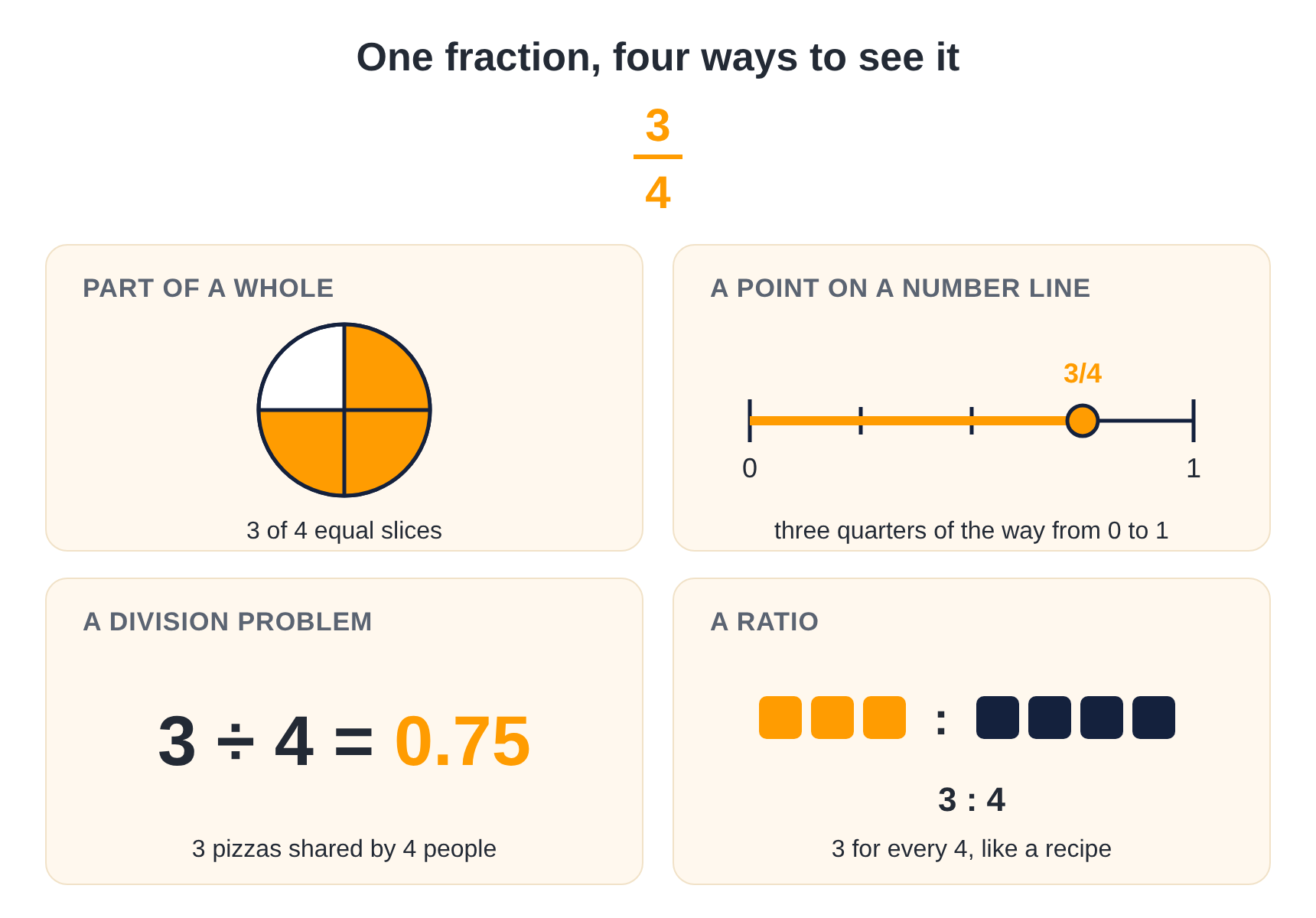
Math ideas are abstract, and the same idea can usually be reached in several ways. Take fractions: a fraction can be a slice of pizza, a point on a number line, a division problem or a ratio. A child who didn't get the pizza version isn't necessarily "bad at fractions." They may just need the number line.
That's why a strong math tutor has more than one way in. When the first explanation doesn't land, they don't repeat it slower and louder; they switch. And because every topic in math builds on the one before it, a poor fit adds up quickly. A child who never really understood fractions will feel it again in algebra a few years later.
Notice what helps your child understand math
Before you compare tutors, think about the last time math clicked for your child, and the last time it didn't. The patterns below aren't fixed learning styles, and most kids show more than one depending on the topic. They're clues about what helps your child understand a problem, and where a tutor may need to adjust.
| If your child... | Look for a tutor who... | Ask them |
|---|---|---|
| Gets it when you draw it | Sketches, uses number lines, area models and graphs, and lets your child draw too | "How would you draw this for my child?" |
| Keeps asking "but why?" | Explains where a rule comes from before practicing it | "Why does flipping the fraction work when you divide?" |
| Needs clear structure | Works through solved examples step by step, then gradually lets go | "What does a typical lesson with you look like?" |
| Handles exercises but freezes on word problems | Teaches how to turn a sentence into an equation, not only how to solve it | "How do you teach word problems?" |
| Knows the material but makes careless mistakes | Builds habits for checking work, rather than just adding more practice | "What do you do about careless mistakes?" |
| Gets anxious or gives up fast ("I'm just not a math person") | Lets them try before stepping in, builds small wins, and never makes them feel slow | "What do you do when a student gets stuck?" |
If your child doesn't fit neatly into any row, that's normal. Tell the tutor what you've noticed on the first call. They can use it as a starting point and form their own picture after a lesson or two.
Check the fit for your child's math level
1. Look for experience with the exact course
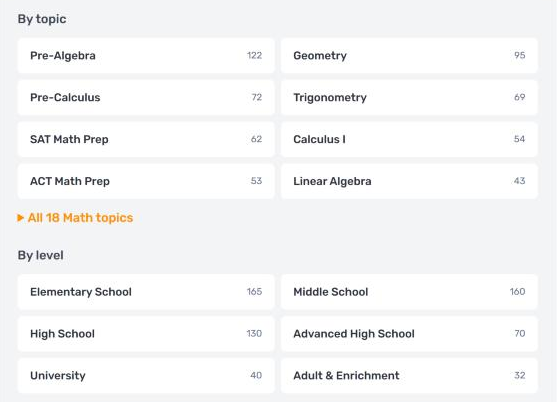
"Math" covers a huge range. A tutor who is great with AP Calculus isn't automatically the right person for Pre-Algebra, and the reverse is true too. It's not only about knowing the material: explaining negative numbers to a sixth grader is a different skill from explaining limits to a high school senior. On Tutorela you can search by the exact course or stage, from elementary school math and pre-algebra through geometry, pre-calculus and AP Calculus.
2. Make sure they trace gaps backward
When a student struggles with this year's topic, the problem often started earlier. Trouble with equations can go back to fractions, and trouble with fractions can go back to division. Strong math tutors check the foundations before pushing forward, even if that means spending a lesson on material that looks "too easy." It's worth asking directly: "How would you find out where my child's gaps are?"
3. Check they know how school teaches it today
Many parents open their child's math homework and don't recognize the method: area models for multiplication, number bonds, several strategies for a single problem. Many U.S. math curricula use visual models and multiple strategies like these, especially in elementary and middle school. A tutor who is familiar with your child's curriculum can connect these methods to what happens in class. If they do show a different way, they should explain how it fits with the one from school, rather than leaving your child with two methods that seem to clash.
Questions to ask a math tutor before you book
On Tutorela, you talk to a tutor on the phone before the first lesson, and reaching out costs nothing, so you can do this with two or three tutors. These checks fit into that call or the first lesson.
4. Ask them to explain it another way
Pick a topic your child is stuck on and ask the tutor how they would explain it. Then ask: "And if that doesn't click?" You're listening for a genuinely different second approach, not the same explanation, only slower.
5. Show them a wrong answer
Show the tutor a problem your child got wrong. A strong math tutor won't just correct it; they'll want to understand what your child was thinking. Math mistakes usually follow a logic of their own. A child who says 0.25 is bigger than 0.3 "because 25 is bigger than 3" doesn't need more decimal worksheets. They need someone who spots that idea and untangles it.
6. Watch who's holding the pencil
In the first lesson, notice who does most of the talking and solving. If the tutor solves while your child nods along, it can look like understanding, but usually it isn't. Tutors do need to demonstrate sometimes, especially with a new topic. But over the lesson, the work should shift to your child, with the tutor asking more than they tell.
7. For online lessons, make sure they can see the work
In math, the steps matter as much as the answer, so the tutor needs to see your child write, while they're writing. Ask: "How will you see my child's work during the lesson?" Good answers include a shared digital whiteboard, a tablet with a stylus, or a camera pointed at the page. "Just tell me your answer" isn't one of them.
Match the method to the goal
The same child may need a different approach depending on what you're working toward:
- A test coming up soon: the focus is on the methods and question types the test uses. There isn't time to rebuild everything, and the tutor should say so honestly.
- Gaps that keep growing: the focus is on understanding the ideas, even if progress feels slower at first.
- The SAT, ACT or an AP exam: on top of the math itself, the tutor should know the test's structure, timing and tools. The digital SAT, for example, has a Desmos graphing calculator built into the test, and using it well is part of the prep. Look for tutors who offer SAT math prep or ACT math prep.
Whatever the goal, a good sign is a tutor who asks about it before choosing an approach.
Signs the method isn't working (even if grades look OK)
- Your child can solve problems with the tutor, but not alone.
- They remember the steps, but get stuck when a problem looks slightly different.
- They can't explain, in their own words, why they did what they did.
- Lessons end with "we finished the worksheet," but the next worksheet is just as hard.
Noticing one of these early is useful, not a failure. Bring it up with the tutor first and see whether they adjust. If nothing changes, our guide to the signs your tutor isn't the right fit walks through what to do next.
How to tell your child is making progress
Don't look at grades alone. After a few lessons, ask your child to solve a problem similar to one they practiced, without help. Can they explain their steps? Do they notice when an answer doesn't make sense? Ask the tutor which skills have improved and what still needs work. Small signs of independence often show up before grades do.
What matters less than you'd think
| Often overrated | Look at this instead |
|---|---|
| An advanced math degree, on its own | Experience explaining math to students at your child's level |
| A tutor for whom math always came easily | How well they understand why it's hard for others |
| How much material each lesson covers | Whether your child can do it alone afterward |
| Living nearby | Whether the tutor can follow the work: online math lessons can work well when the tutor sees your child's reasoning in real time |
Subject depth does count for more as courses get harder. For calculus and college-level math, or for a student who also needs help with the math in physics, deep knowledge of the material carries real weight. Even then, a tutor still needs to be able to explain it at your child's level.
Ready to find a math tutor who fits? Browse by course and level, and talk to a few tutors before you book, for free.
Frequently asked questions
My child says they're "not a math person." Can the right tutor change that?
Often, yes. Many kids who say this have met one way of explaining that didn't work for them, or have gaps that make every new topic feel harder. A tutor who finds those gaps, explains in a way that fits, and builds small wins can change how a child feels about math. It takes time, so look for confidence first and grades second.
Should I tell the tutor how my child learns, or let them figure it out?
Tell them. You've watched your child do homework far more than any tutor has. Share what you've noticed: where they get stuck, what helped before and what made things worse. The tutor can use it as a starting point and refine it after a few lessons.
Is online math tutoring as effective as in person?
It depends on the student, the tutor and the setup. Online math lessons tend to work well when the tutor can see your child's work as they write it, through a shared whiteboard, a tablet or a camera on the page. Some students, often younger children, still do better with someone sitting beside them.
How many lessons before I know the method fits?
Usually two or three. By then you should see the tutor adjusting to your child, and your child trying more on their own. Progress in grades often takes longer, especially when there are gaps to fill.
Do I need a different tutor for SAT math than for regular math help?
Not necessarily, but it's worth asking. Test prep calls for knowing the test's structure, timing and tools. Some tutors do both well, while others focus on one.