
TL;DR, what matters most
- First impressions form fast: within ~5 minutes your child sizes up the tutor, and that impression colors everything after.
- Emotional prep is the key: a child who knows why they have a tutor shows up curious, not anxious.
- Logistical prep removes friction: a ready space, materials on hand, and working tech let your child focus on learning.
- The parent's role is precise: be available but not hovering, give private space, while keeping safety in mind.
- A fair evaluation takes time: give it 2–3 lessons before deciding, a first impression can mislead.
- Communication is everything: short talks with your child and the tutor afterward tell you if it's a good match.
What's inside
When families look for a tutor, most parents put real time into choosing the right one, comparing prices, reading reviews, checking experience and credentials. And after all of that, there's one critical step that often gets overlooked and can quietly undermine all that hard work: preparing the child themselves for the first lesson.
The first lesson isn't just a "meet and greet." It's the moment the tutor–student relationship begins to take shape, and it can color much of what follows. Get it right and the first lesson becomes the opening chapter of a successful learning journey, instead of a confusing or frustrating start.
Why the first lesson matters so much
Before the practical tips, it's worth understanding why the first lesson deserves so much attention. The short answer: it's the foundation for your child's entire learning process.
First impressions form fast
Classic research on "thin slices" of behavior found that people form an impression of a teacher remarkably quickly: judgments based on silent video clips as short as 6 to 30 seconds predicted how students rated that same teacher at the end of the semester.1 In other words, the impression forms almost immediately, and it tends to stick.
An impression of a teacher can form in seconds, and it tends to stick.
Why the relationship matters
That first impression becomes the foundation of the tutor–student relationship. And a good relationship isn't just "nice to have", it's linked to real differences in how students learn. A large meta-analysis of teacher–student relationships (99 studies) associates a positive relationship with:
- Motivation: the child wants to learn, not just "has to"
- Engagement: takes part, asks questions, takes ownership
- Confidence: believes they can succeed
- Persistence: doesn't give up when it gets hard
- Achievement: better grades and deeper understanding (a smaller, but real, effect)2
A rare chance to change the story
When a child struggles with a subject in a big classroom, they often develop a negative "story" about themselves: "I'm just not a math person," "this isn't for me." Say the subject is chemistry: a class of thirty moves on whether or not your child followed the lesson, while a private chemistry tutor can stop at the exact step where it stopped making sense. Kids who get that kind of one-on-one support often start to develop a more positive attitude toward the subject, seeing it as interesting rather than threatening, and that shift drives success.
The first lesson with a tutor is the chance to break that story, but only if your child shows up open and ready. That's exactly why preparation is so critical.
Two possible paths
| Without proper prep | With proper prep |
|---|---|
| Anxiety & fear → shutting down → hard to build trust → the negative story gets reinforced | Curiosity & openness → a basis for trust → motivation & engagement → "I can do this!" |
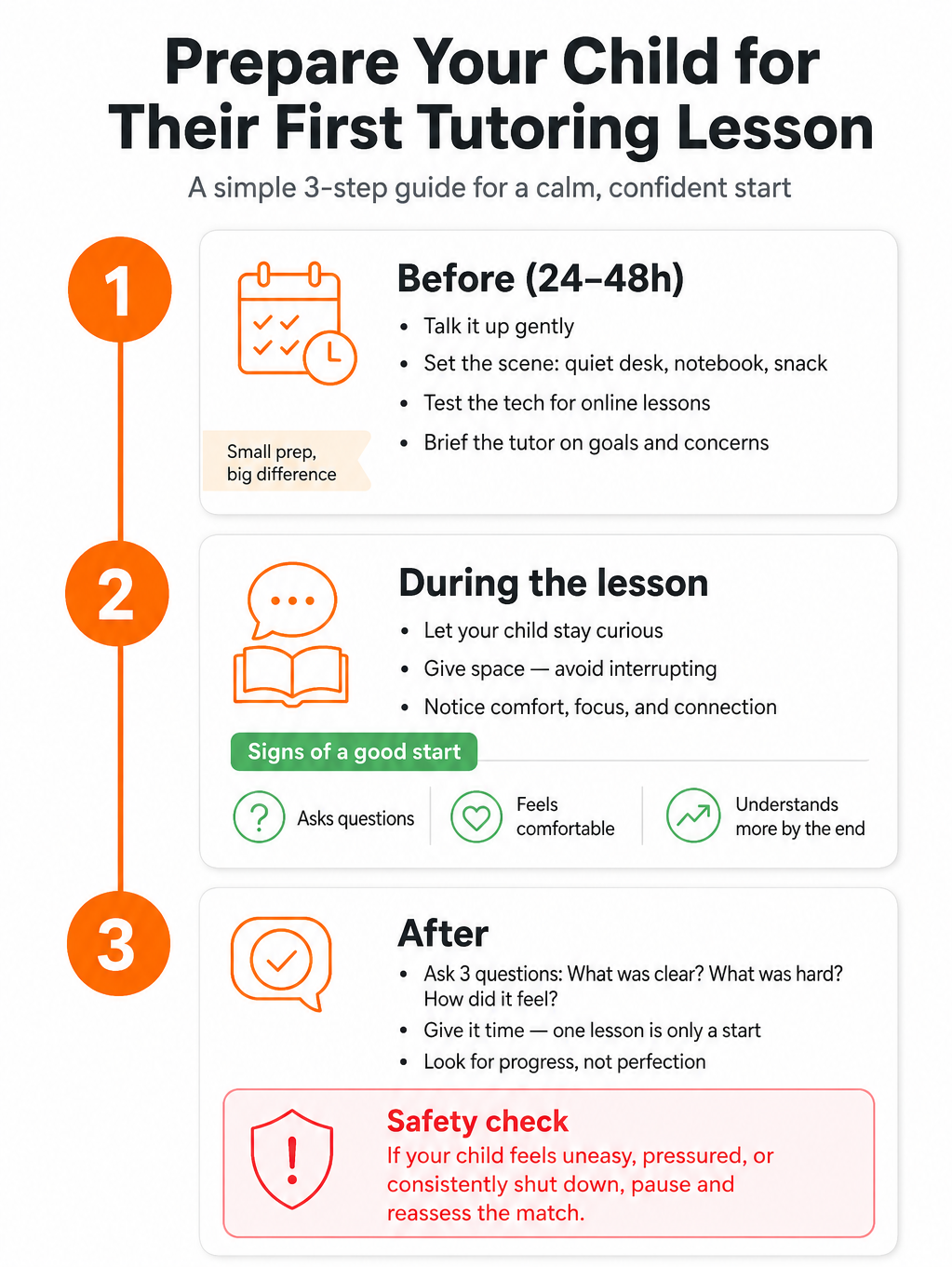
So what do you do? The question is no longer "does the first lesson matter?", that's clear. The question is how to prepare your child so it becomes the starting point of a success story. Let's get practical.
Part 1: Emotional and mental prep
Prep breaks into three areas: emotional, logistical, and communication with the tutor. We'll start with the most important, emotional prep.
Step A: Set realistic expectations
Kids fear the unknown, but when they know exactly what to expect, fear turns into curiosity. Here's what to tell your child about the first lesson:
- It's mostly about getting to know each other: no one expects you to know everything.
- The tutor wants to understand where you are: this isn't a test; it's so they know how to help.
- It's okay not to understand: that's exactly why the tutor is here!
- You can ask anything: there are no "dumb" questions.
- The goal is to learn, not to get a grade: no test pressure, no grades.
- The lesson will be tailored to you: the tutor matches pace and style to how you learn.
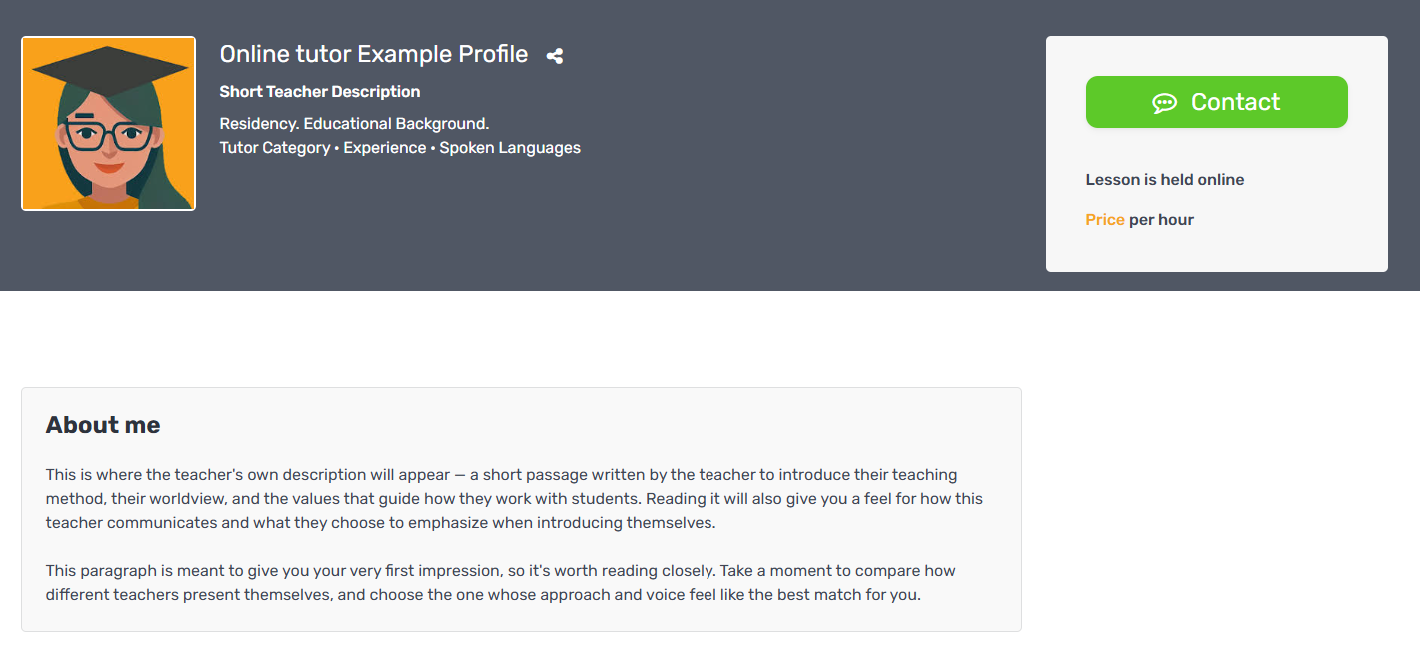
Show your child who they are about to meet. Open the tutor's profile together: the photo, the subjects they teach, their experience and what other students wrote about them. On a Spanish tutor's profile, for example, your child can see exactly who they will be speaking with long before the lesson starts, and two minutes there mean the first lesson begins with a familiar face instead of a stranger.
Step B: Language, how to talk about the tutor
Frame tutoring not as "help because you're not good enough," but as an investment in your child's success.
| ❌ Stressful (avoid) | The situation | ✅ Empowering (recommended) |
|---|---|---|
| "You need a tutor because you don't get it in class" | Framing | "We want to give you the best tools to succeed" |
| "Let's see if this finally helps you" | Attitude | "A tutor will help you understand it in a way that works for you" |
| "If you don't improve with the tutor, we're out of options" | Pressure | "Lots of successful students work with a tutor, it's an advantage!" |
| "All your friends are ahead, you need to catch up" | Comparison | "This is a chance to learn at your own pace and really get it" |
The empowering message: a fresh start
Instead of: "Let's see if this tutor helps you." Try: "You're about to meet someone who'll help you understand this in a way that fits you exactly. This is a fresh start!"
Step C: Match your approach to your child's age
Kids at different ages process information differently, so tailor how you talk about the tutor.
🎒 Elementary (grades K–5)
- Use familiar comparisons: "A tutor is like a personal coach for learning. Just like there's a soccer coach, there's a coach for math!"
- Keep it short and simple: "The tutor is coming to help you. You'll learn together."
- Make it sound fun: "It'll be like playing a game, except you'll learn, too."
Why: kids this age understand best through concrete examples and comparisons to things they know.
📚 Middle school (grades 6–8)
- Emphasize the advantage, not the weakness: "A tutor helps you understand in your own way, without the pressure of a big class."
- Give them a sense of control: "You'll be able to ask any question you don't feel comfortable asking in class."
- Normalize it: "Plenty of successful students work with a tutor, it's no big deal."
Why: young teens are highly sensitive to how they're perceived and care a lot about what others think.
🎓 High school (grades 9–12)
- Talk to them like an adult: "This is an investment in your future, a tutor helps you hit your goals on the SAT/ACT, in your AP classes, and for college."
- Emphasize long-term goals: "This isn't just about the next grade; it's about skills you'll use for the rest of your life."
- Give them full ownership: "You'll decide with the tutor what to work on and how, this is your process."
Why: high-schoolers can grasp complex ideas and think about the future. They appreciate a direct, respectful conversation.
Step D: Handling common fears
Even after setting expectations, many kids still show up with specific worries. You can, and should, meet them head-on.
| The child's fear | Why they feel it | A helpful response |
|---|---|---|
| "I'm scared the tutor will see I don't understand anything" | Fear of shame | "That's exactly why the tutor is here, it's their job! There's nothing to be embarrassed about." |
| "What if they ask me questions and I don't know?" | Performance anxiety | "This isn't a test, it's a conversation. If you don't know, that's the whole point of them being here." |
| "What if they go too fast?" | Fear of not keeping up | "Your tutor is teaching only you, at your pace. You can say 'stop, I don't get it', that's totally fine." |
| "What if I don't click with the tutor?" | Personality mismatch | "We'll try it, and if something doesn't feel right, we can change it. The first lesson is a test run too." |
| "I don't want more lessons, I'm tired" | Overload | "The tutor helps you understand things faster and more easily. In the end, it saves you time and effort." |
| "It's embarrassing, no one else needs a tutor" | Social judgment | "Actually, lots of successful students work with a tutor. It's like a personal trainer, an advantage, not a weakness." |
💡 Important tip
Don't brush off your child's worries or say "it's not a big deal." Acknowledge the feeling ("I get that you're nervous"), then give a response that shows you understood the worry and that there's a solution.
Part 2: Logistical prep
Prep A: Align with the tutor (24–48 hours before)
Have a quick chat 24–48 hours before, 5–10 minutes, or a detailed message, to share what helps the tutor prepare. This isn't "interfering." It makes things easier for both the tutor and your child.
- What's the goal? Better grades? Test prep? Closing gaps? General understanding?
- Where does your child struggle? Specific topics (multiplication, fractions) or the whole subject?
- Your child's personality: shy? outgoing? needs lots of encouragement? gives up quickly?
- Any specific needs: attention or learning differences the tutor should adapt for.
- What has and hasn't worked before: if there were previous tutors, what was good and what wasn't.
- What does your first lesson usually look like?
- What should my child prepare or bring in advance? (This helps you get materials ready.)
- How do you usually work with students?
- How will we get progress updates? (After each lesson? Weekly?)
- (For online) Which platform will we use? Anything to install ahead of time?
Prep B: The space and materials
Now that you've aligned with the tutor and know what's needed, set up the space and materials.
What should be ready on the desk
How to set up the space
- A clean, tidy desk, no distractions (phone, games, clutter)
- Good lighting + a comfortable chair for an hour of learning
- Relative quiet, TV off, siblings elsewhere, parents not hovering
- Check it 24 hours ahead, not at the last minute!
- Software installed, Zoom / Google Meet, or whatever the tutor specified
- Internet + camera + mic tested (fast.com for a speed check)
- Your child knows the basics, camera on/off, screen share
Lesson day: what to do
The morning before the lesson
Gently remind your child there's a lesson today. Keep it calm, just a heads-up.
A light meal, learning hungry is hard, but so is learning right after a heavy meal.
Check that everything's ready, materials, space, connection. Don't leave it to the last minute!
A calm, reassuring moment: "Ready? The first lesson is mostly about getting to know each other. No pressure, enjoy it!"
Give the tutor and child space, parents usually don't need to be in the room (unless asked).
⚠️ What NOT to do before the lesson
- Don't pressure your child with "try hard," "listen closely"
- Don't cram material at the last minute
- Don't emphasize how much it costs ("we're paying a lot, so focus!")
- Don't turn it into a big, stressful event
15 minutes before: final checklist
- All materials in place and ready
- The space is quiet and tidy
- Stable internet (for online lessons)
- Your child is calm, not hungry or tired
- Parent's phone on silent/vibrate
During the lesson: the parent's role
- Be available: in case something's needed, but not in the room
- Give privacy: your child needs a safe space to learn and to make mistakes
- Stay positive: a smile if they see you, but don't get involved
- Don't jump in: even if you hear a mistake, let the tutor handle it
- Don't correct: that's the tutor's job
- Don't comment: "I told you!" only confuses and stresses
- Don't "help": sitting beside your child confuses the tutor
💡 When to stay and when to step out?
⚠️ Safety first: before leaving your child alone with a tutor, it's very important to know the tutor. If it's someone you don't know or a first meeting, stay nearby.
| Child's age | A familiar tutor | A new / unfamiliar tutor |
|---|---|---|
| 🎒 Young (through ~3rd grade) | In the room for the first few minutes, then step into a nearby room | Stay nearby: door open or in the next room |
| 📚 Older (middle school+) | Give privacy from the start, they don't need you in the room | For the first lessons, be available at home; more privacy later |
| 💻 Online lessons | Step out once the connection works, stay available at home | — |
After the first lesson: evaluate and decide
The first lesson is over, but the work isn't done. What happens right after is your chance to gauge how it went and decide on next steps.
Talk with your child
| ✅ Good questions to ask | ❌ Questions to avoid |
|---|---|
| "How was it? What did you like?" | "Did you understand everything?" (pressure) |
| "How did you feel with the tutor?" | "What grade did you get?" (no grades in a first lesson!) |
| "Did you learn something new?" | "Did the tutor say you're good?" (seeks approval) |
| "Do you want to continue?" | "Now you'll finally succeed?" (needless pressure) |
Talk with the tutor
After the lesson (not during it!), talk with the tutor to understand what happened and what's ahead.
- How did my child respond? Were they open and comfortable?
- What are the strengths? What is my child already doing well?
- Where's the work needed? Which areas are hardest?
- What's the plan? How will you progress in the coming lessons?
- How long until improvement? When might we see first results?
- Updates? How will you keep me posted?
Deciding whether to continue
The first lesson is also a test: are the tutor and child a good fit? Evaluation happens in two stages.
Stage 1: The first impression (right after)
| 🟢 A good feeling | 🔴 A not-so-good feeling |
|---|---|
| Your child seems comfortable, "it was fine," "nice" | Your child shut down, afraid to talk |
| Open communication, asked questions, wasn't afraid to speak | The tutor didn't listen, cut them off |
| The tutor matched the explanation to your child's level | A tense atmosphere, judgment or impatience |
| Room to make mistakes without fear | The tutor seemed frustrated when your child didn't get it |
| A connection, maybe a moment of humor or shared interest | Your child left as confused as they came in |
| Your child wants to continue | Strong refusal, "this isn't for me" after one lesson |
Stage 2: A deeper evaluation (after talking with both)
| 🔴 Not a fit | Criterion | 🟢 A fit |
|---|---|---|
| "This isn't for me," "I didn't like it" | Child's feeling | "It was fine," "I want to continue" |
| The tutor didn't listen or cut them off | Communication | The tutor listened and let your child talk |
| Your child understood nothing | Understanding | Your child "gets it a little better" |
| The tutor seemed impatient | Attitude | The tutor seemed encouraging and supportive |
| A tense, unpleasant atmosphere | Atmosphere | Moments of humor / connection |
⏱️ Give it a chance, but don't force it
One lesson isn't always enough. Sometimes both the child and the tutor need 2–3 lessons to find their rhythm. But if you still don't feel a connection after that, experience says it's worth looking for another tutor. One exception: if your child feels unsafe, humiliated, or pressured, or you notice anything that concerns you about the tutor's conduct, don't wait it out. Stop and find someone else.
Summary and takeaways
The first lesson with a tutor is far more than a "meet and greet": it's a turning point that can meaningfully shape your child's learning path. Across both the published research and our own experience, more than 500,000 lessons and 15 years of working with families, the through-line is the same: the first lesson matters, and good preparation gives it the best chance to become the start of a lasting, successful match.
🔑 The four keys to a great first lesson
- Emotional prep: your child understands this is an opportunity, not a punishment
- Logistical prep: everything's ready and organized, no needless friction
- Good communication: with the tutor and with your child, before and after
- Realistic expectations: understanding this is a process, not magic
The first lesson isn't an endpoint, it's a starting point for a learning journey that can change your child's future.
Frequently asked questions
How long until we see results?
Research reviews generally find that good tutoring can add several months of extra progress over a school year, though how much depends heavily on the student's starting point, the subject, and how often lessons happen. In practice, you'll often see early signs after a few lessons, while a clear jump in grades usually takes longer. Agree on short-term goals with the tutor and check in on progress at regular intervals.
What if my child doesn't want a tutor at all?
Very common. Try to understand why, fear? embarrassment? being tired? It often helps to let your child "try it once" with no commitment, so they see it isn't scary. If they're strongly opposed, consider waiting a bit, or finding a tutor your child helps choose (which gives them a sense of control).
Can online lessons be as good as in-person?
Yes, when the setup is right. Online lessons have grown from about 10% of sessions in 2019 to roughly half in recent years, and in our experience they can be just as effective as in-person when there's a stable connection, a skilled tutor, and a child who's comfortable with the format. The upside: convenience, flexibility, and access to tutors from anywhere.
How many times a week should we meet with a tutor?
It depends on the goal. Big gaps: 2–3 times a week. A boost: once a week is enough. SAT/ACT or AP prep: sometimes twice a week during crunch time. Consistency matters more than volume, a steady once a week beats three times one month and then nothing.
What if my child says they don't want to continue after the first lesson?
Don't panic. Try to understand why, was it hard? embarrassing? boring? Sometimes it's just first-time jitters. Give it another 1–2 lessons. If it's still not working after 3, consider a different tutor. It's completely normal to try a few before finding the right fit.
How do I know the tutor is actually helping?
Positive signs: your child understands things they didn't before, is less frustrated, and says "the tutor explained it and now I get it." After a few lessons you should also see grades or tests improve. Warning sign: no change at all after ~10 lessons, check whether the tutor is the right fit.
Do parents need to be present during lessons?
Usually not. Kids need private space to feel comfortable asking questions and making mistakes. Be available, but not in the room. Exception: very young children (through ~2nd–3rd grade) sometimes feel safer with a parent nearby (but not involved). And remember: before leaving your child alone with a tutor, it's very important to know the tutor.
What if my child is embarrassed about having a tutor?
Common, especially in middle and high school. Normalize it, "lots of successful students work with a tutor; it's like a personal trainer, but for school." Frame it as "because you want to get even better," not "because you're not good." Letting your child choose home vs. online (online is more private) can help too.
Ready to find the right tutor for your child?
Tutorela is the international brand of a platform with more than 15 years behind it, now focused on families in the United States, with over 15,000 approved tutors. Search, read real reviews, and start the journey toward success.
Find a tutor now →Sources
- Ambady, N., & Rosenthal, R. (1993), Half a Minute: Predicting Teacher Evaluations from Thin Slices of Nonverbal Behavior and Physical Attractiveness. Journal of Personality and Social Psychology, 64(3), 431–441.
- Roorda, D. L., Koomen, H. M. Y., Spilt, J. L., & Oort, F. J. (2011), The Influence of Affective Teacher–Student Relationships on Students' School Engagement and Achievement: A Meta-Analytic Approach. Review of Educational Research, 81(4), 493–529.