
The short answer
Choosing the right kind of tutor, in a snapshot
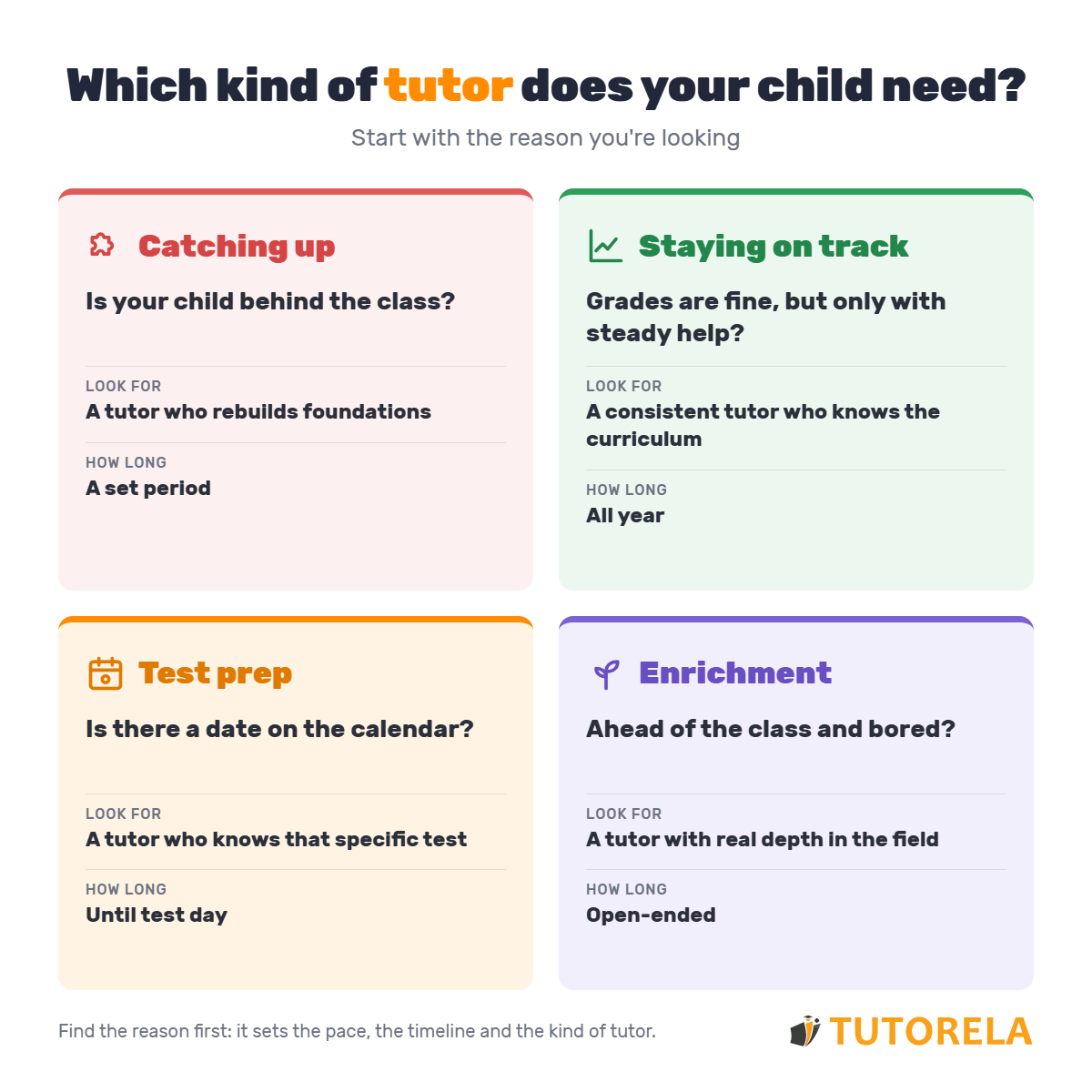
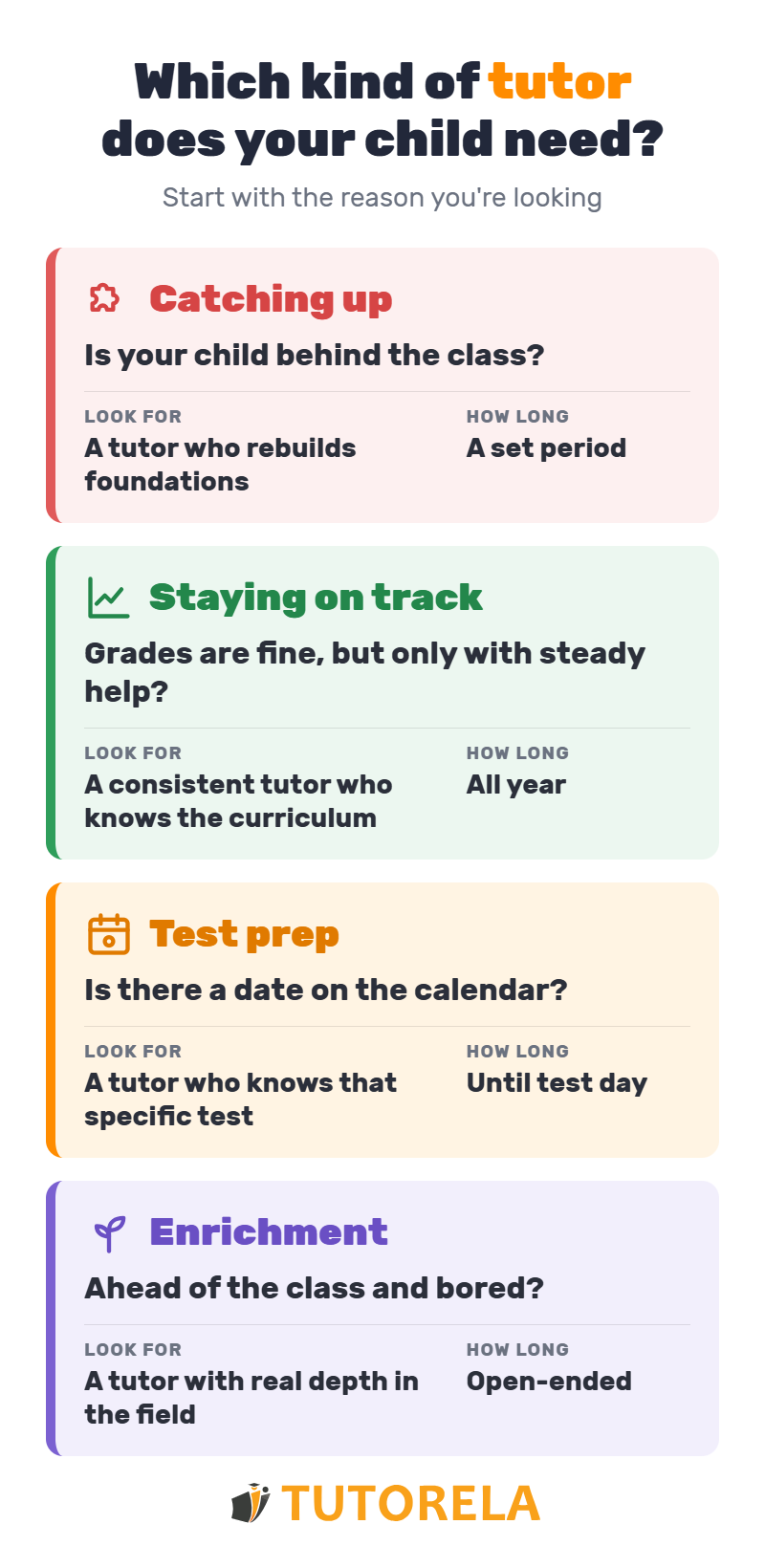
A child usually needs a tutor when something specific isn't working, or isn't enough, at school: they're falling behind, they only keep up with steady help, a big test is coming, or they're ahead and bored. Each of these four reasons sets how often to meet, for how long, and which tutor fits.
- Catching up: a set period, often starting at two sessions a week, with a tutor who rebuilds foundations.
- Staying on track: one steady weekly session all year, with a consistent tutor who knows the curriculum.
- Test prep: a plan built backward from test day, with a tutor who knows that specific test.
- Enrichment: open-ended, once a week or every other week, with a tutor who has real depth in the field.
- More than one reason: start with the most urgent one, and adjust the plan as the need changes.
The session counts here are practical starting points from our team's experience with private tutoring, not research findings. The right schedule depends on your child, the subject and how much practice happens between sessions.
Before you ask "who's a good tutor?", it's worth asking "why do we need one?" The answer decides how often your child should meet a tutor, for how long, what kind of tutor fits, and how you'll know it's working.
This guide walks through the four most common reasons, what research says about the right pace for each, and five questions to answer before you message a single tutor. The recommendations come from our team's 15+ years of running a tutoring marketplace, with more than 500,000 lessons and 15,000+ approved tutors. Tutorela is the platform's international brand, and right now it's focused on families in the United States.
In this article
- Why "we need a tutor" isn't enough
- Need 1: Catching up on missed skills
- Need 2: Staying on track all year
- Need 3: Test prep with a fixed date
- Need 4: Enrichment for kids who are ahead
- When you don't need a tutor
- The four reasons side by side
- What if you see more than one reason?
- Five questions to answer before you search
- How this helps you search on Tutorela
- FAQ
Why "we need a tutor" isn't enough
Four parents post the same question in their school's parent Facebook group: "Does anyone know a good math tutor?" Same words, four very different situations:
- A son who has been shaky since fractions in 5th grade and is now lost in 8th-grade algebra.
- A daughter whose grades are fine, but only because someone sits down with her every week.
- A junior with the AP Calculus exam in three months.
- A kid who finishes every test first and spends the rest of class bored.
If all four get the same recommendation, they'll likely end up with the same kind of tutor, the same pace and the same plan, and it won't work for most of them. A relaxed once-a-week tutor won't be enough for the student whose exam is a month away. A tutor built for advanced challenges will frustrate the child who's missing foundations. And a patient tutor who loves going back to basics will bore the kid who already knows the material.
Fit can affect cost, too, not just results. A tutor who fits the goal can get there in fewer lessons, so the total you spend depends on more than the hourly rate. That's also why picking a tutor on price alone often backfires.
Reviews tell the same story one family at a time. Here's one high school student who had tried several tutors before the match worked:
Rated 10/10
I had a hard time with English and with the reading-heavy subjects on my matriculation exams, and I'd tried quite a few private tutors. Something there didn't work, and I couldn't get myself to book another lesson. After my first lesson with Rachel, I knew this time was different. … Rachel knew how to bridge the gaps and how to approach my difficulties. … I didn't just pass my tests, I really understood the material.
A review from Tutorela's sister platform. Translated, names changed.
For this student, the difference came from a tutor who understood both the material and the way he learned.
So before comparing tutors, get clear on what your child actually needs help with. The rest of the search gets much easier.
Need 1: Catching up on missed skills
Catching up means rebuilding skills your child missed earlier, so they can keep up with what the class is learning now.
Homework that should take 30 minutes takes two hours. Your child says it all makes sense in class, then gets stuck alone at the kitchen table. Grades slip a little at a time, and you can't quite say when it started.
That's often a sign of a gap: a topic your child didn't fully get when it was taught. Since new material builds on old material, the gap spreads into topics that look unrelated.
The most common mistake is to help only with this week's homework. It brings relief for a few days, then the struggle returns with the next unit, because the missing piece underneath is still missing.
A gap can start with a clear event, like a long illness, a move or a school change, or it can build quietly. And it isn't only a math thing. A child who struggles with reading comprehension will feel it in every subject with long word problems or reading-heavy assignments.
Catching up usually has an end date
Closing a gap is typically a defined project: more frequent sessions at the start, then a lighter pace once the foundation is rebuilt.
School-based research points the same way. The UK's Education Endowment Foundation found that one-to-one tutoring works best in short, regular sessions of about 30 minutes, three to five times a week, over a set period of up to ten weeks. Those are tutoring programs run by schools, not private lessons. A 2024 meta-analysis of 89 randomized trials by Nickow, Oreopoulos and Quan found the largest effects in programs that met at least three days a week.
So the research doesn't give you an exact number of private lessons. What it does suggest is that for a child who's significantly behind, a focused stretch of more frequent support tends to do more than one weekly session with no end in sight. For private tutoring after school, here's a practical starting point from our team's experience:
- Big gap: start with two sessions a week.
- Small gap: one session a week, plus short practice in between, may be enough.
- Some kids need longer: that's fine. The right pace also depends on your child's schedule and how much practice happens between sessions.
A useful checkpoint is after 8 to 10 sessions. If you see no change in understanding or confidence by then, talk to the tutor.
When it works, it can look like this:
Rated 10/10
Teaches everything with a lot of patience and professionalism. Our son went up from 3 units to 5 units after only 4 months! Ethan listens to the child and adapts his method to him! Unbelievably smart, and a pleasure to work with! In short, there's no one better than him...
A review from Tutorela's sister platform. Translated, names changed. In Israel's high school exit exams, 3 units is the standard level and 5 units is the most advanced.
That's one family's experience, not a typical result. But it shows what a good catch-up looks like: a focused stretch with a clear finish line.
If two sessions a week are outside your budget: one session with structured practice in between can still work. Ask the tutor to leave short assignments for the days in between, focus the sessions on the gaps that block the most current material, and add whatever free help the school offers.
Which tutor fits?
Look for a tutor who isn't afraid to go back. In the first sessions, they should pin down exactly where the gap is and build up from there.
Picture an 8th grader whose private math tutor takes her back to 5th-grade fractions. That isn't wasted time. It's exactly what she needs. A tutor who sticks to current material may get her through the next quiz, but the gap stays.
Experience matters here: an NBER review by the same researchers found that programs using teachers and trained paraprofessionals tended to produce larger gains than programs using volunteers or parents. That's a different comparison from an experienced versus a newer private tutor, but it does suggest that teaching skill matters when the job is rebuilding foundations.
Not every struggle points to a learning difference. But if you suspect one, such as dyslexia, ADHD or dyscalculia, there are two parallel steps. First, you can ask your child's public school in writing for a free evaluation. Services through an IEP, or accommodations through a 504 plan, depend on what the evaluation finds and on eligibility rules, not on a diagnosis alone. Second, look for a private tutor with specific training in learning differences, who can work alongside the school's support rather than instead of it.
How catching up looks, step by step
- Find the hole: the first sessions focus on where the foundation broke.
- Rebuild: go back to the missing material, even from earlier grades, and build it properly.
- Connect to class: link what was rebuilt to what's happening in class now, so your child feels the difference at school.
- Check and decide: after 8 to 10 sessions, stop and assess. Gap closed? Drop to once a week, or wrap up.
Need 2: Staying on track all year
Staying on track means steady, ongoing support for a child who is at grade level, so they stay there.
Grades are fine. Parent-teacher conferences hold no surprises. But you know your daughter wouldn't open her notebook if someone weren't sitting with her. You're thinking about stopping the sessions, and you're worried everything will slide.
Some parents feel odd paying for tutoring when things are going well. But sometimes things are going well because of the tutoring. The goal here isn't to race ahead. It's to hold on to what your child has already built.
This kind of steady support makes the most sense:
- In subjects where each unit builds on the last. Say the subject is chemistry: a class of thirty moves on to stoichiometry whether or not your child followed moles, and a weekly session with a private chemistry tutor keeps each unit solid before the next one lands.
- For kids who closed a gap in the past and need to keep it closed.
- For kids who find it hard to practice without structure.
Writing is another good example. Essay structure, reading comprehension and grammar develop over years, not in a two-week cram before a test. A student who's managing today but stops practicing may discover in junior year, right when AP English and college essays arrive, that they've fallen behind. A steady English and writing tutor helps prevent that.
Why it works
Without review, we forget fast. Ebbinghaus's classic forgetting curve was replicated in 2015 with similar results: most forgetting happens in the first days after learning. Regular review, in a session and in short practice between sessions, brings material back before it fades.
Summer is the big test. A 1996 review of 39 studies by Harris Cooper and colleagues found that test scores tended to dip over summer break, more in math than in reading, and later NWEA research found the dip can grow in relative terms through middle school. Researchers still debate how big summer loss really is, and it varies a lot by student and subject. The practical point: with a US summer break of ten weeks or more, some light review helps strong students too.
What it looks like in practice
- During the school year: one session a week, same time each week, aligned with what the class is covering.
- Before midterms and finals: add a session or two.
- Summer: drop to every other week, just enough to keep things warm.
Which tutor fits?
For ongoing school support, a reliable tutor who knows the curriculum is often a better fit than a highly qualified specialist who's rarely available. Look for someone who can build a relationship with your child over months. A newer tutor who's good can be a great fit here, and is often more affordable.
The goal isn't to keep a weekly appointment forever. Every few months, check with the tutor whether your child can hold the same progress with less support, like every other week, or practice on their own with a check-in before tests.
Need 3: Test prep with a fixed date
Test prep means a plan built around one exam on a known date, like an AP exam, the SAT or a final.
Plenty of families plan to start AP prep in the fall and end up searching in February, with three months to go.
When there's a test with a date, the date sets the plan: when to start, how fast to go and what to do at each stage. This applies to AP exams, the SAT and ACT, end-of-course and state exams, finals, and college courses like intro statistics or organic chemistry.
The US calendar has a few fixed points worth knowing. The 2027 AP exams run May 3 to 14, and many schools order exams in the fall. The SAT is offered several times a year, so for the SAT and ACT you usually pick the date, then plan backward from it. Finals cluster in December or January, and again in May or June.
Why starting early pays off
In a study of more than 1,350 people published in Psychological Science (Cepeda et al., 2008), participants learned facts, reviewed them after different gaps, and were tested up to a year later. The further away the test, the more it paid to spread reviews out. That study wasn't about tutoring, but the idea carries over: if you have time, one session a week over a few months leaves more room for spaced review than a pile of sessions in the final weeks.
There's also a practical reason. If you start looking for an AP tutor in April, you're looking at the same time as everyone else, and the best evening slots go first.
Which tutor fits?
Look for someone who knows the specific test, not just the subject. A strong private biology tutor may explain cellular respiration beautifully and still not know how AP Bio free-response questions are scored. Ask directly: "How many students have you prepped for this exam, and how did they do?"
A clear first message: "Hi, my daughter is a junior taking AP Biology. The exam is May 3. She's keeping up in class but struggles with the free-response questions. We're looking for someone who knows the AP format, one session a week for now and more as May gets closer."
Plan backward from test day
- Two to three months out (foundations): one session a week. Find the weak topics and strengthen them without pressure.
- About a month out (topic practice): two sessions a week. Work through test-style questions, topic by topic.
- Final weeks (full practice tests): two to three sessions a week. Timed practice tests and a close look at every mistake. Usually no new material, unless an important topic was never covered.
These are general ranges. The real pace depends on your child and the test.
Need 4: Enrichment for kids who are ahead
Enrichment means going beyond the curriculum for a child who is ahead of the class or wants more depth.
Teachers rave about your son at conferences. He finishes tests first, then sits there bored. At home he spends hours on his own projects, but at school he says he's "just waiting." You start to worry the spark is fading.
Enrichment fits a child who's ahead of the class, bored, or eager to go deeper into something. A strong student who stays bored for a long time can lose interest, even in a favorite subject.
Many parents feel guilty about this one, as if tutoring a kid who's doing well is a luxury. It can be one of the most useful things you do.
Research backs the idea that strong students don't need more of what they already know. In a national study of 336 high-ability students in grades 2 to 6 (Reis et al., 1998), teachers cut 40% to 50% of the material those students had already mastered and replaced it with more challenging work. Their achievement test scores held up. That study was done in elementary classrooms and didn't test private tutoring. It does support a useful principle for enrichment: kids who've mastered the material gain more from new challenges than from extra practice.
Good enrichment looks like this:
- Open-ended: no test date, no countdown.
- Measured by output, not grades: a finished project, a new skill, a topic explored in depth. Grades are already high.
- Usually once a week or every other week: much of the work happens between sessions, out of curiosity.
Which tutor fits?
Look for real depth in the field, sometimes someone who works in it and doesn't only teach it. A student who loves code gets more from a computer science tutor who builds a real app with them than from another worksheet. A student who plays piano benefits from a piano teacher who aims lessons at a recital, not just the next piece. When you talk to a tutor, ask what they would actually work on with your child. A specific project or challenge tells you more than a long list of qualifications.
When you don't need a tutor
Not every dip in grades calls for a tutor, and not every strong student needs enrichment. Sometimes something closer to home does the job:
- Talk to the teacher: many teachers offer extra help before or after school, and they can tell you whether the dip is real or a one-off.
- Check what the school already offers: many schools have intervention periods, peer tutoring, a writing or math lab, or free tutoring programs.
- Change study habits: a set homework time, phones in another room, or a weekly planner check can sometimes solve the problem on its own.
- Find challenge elsewhere: a gifted program, a math or robotics club, a science fair project, a library program or a summer camp can feed a bored kid's curiosity.
It's reasonable to wait and watch when:
- Your child understands the material when you ask about it.
- Homework gets done independently.
- The drop showed up on one test and hasn't repeated.
Give it a few weeks. If nothing changes, revisit. Adding sessions out of worry alone isn't a good reason.
The four reasons side by side
| At a glance | Catching up | Staying on track | Test prep | Enrichment |
|---|---|---|---|---|
| Goal | Catch up with the class | Stay steady all year | Do well on one specific test | Go deeper, beyond the curriculum |
| Sessions per week | 2 at first, then fewer | 1, less over summer | 1 at first, 2 to 3 in the final weeks | 1, or every other week |
| How long | A set period with an end | All year, no fixed end | Until test day | Open-ended |
| Key tutor trait | Diagnoses and goes back to basics | Consistent, available, knows the curriculum | Knows the specific test | Deep subject knowledge, shared interest |
| Signs it's working | Your child handles current work alone | Steady grades, no sudden drops | Practice-test scores, then the result | A finished project, a new skill, a topic mastered |
| When to stop | Gap closed: move to steady support or wrap up | Your child holds steady alone | After the test | When the interest or goal changes |
Session counts are starting points from our team's experience, not research findings. Adjust them together with the tutor. On a phone, scroll the table sideways to see all four reasons.
You don't have to wait for a report card to know if it's working. After about a month, check at home whether your child:
- Solves on their own the kind of problems that used to stop them.
- Spends less time on homework.
- Asks you for help less often.
- Can explain why they got something wrong, not just what the right answer is.
What if you see more than one reason?
Pick one main reason to set the pace, and treat the others as secondary.
- If the test is close: the date wins. Work toward it and close only the gaps the test requires.
- If the test is far away: close the gap first. Test prep won't stick without a foundation.
For example, a junior who struggles with algebra has the ACT in two months. A good tutor will usually prioritize the foundations the math questions depend on, strengthen those, and leave the rest for after the test.
Needs also change over time:
- Catching up to staying on track: the gap closes and sessions settle into a calmer weekly rhythm.
- Test prep to done (or to staying on track): after the test, decide together whether to continue.
- Staying on track to test prep: a big test is coming, so add sessions for a short stretch.
- Staying on track to enrichment: your child is steady and wants more.
When the need changes, check that the tutor still fits. A great gap-closer isn't automatically the right person for SAT prep, and that's no one's fault. If you're unsure, these 10 signs your tutor isn't the right fit can help you decide.
Five questions to answer before you search
- Why are you looking now? A bad test or a slow slide points to catching up. An upcoming date points to test prep. A bored kid points to enrichment.
- Is there a date on the calendar? If yes, plan backward from it. If not, you have more room on pace.
- Where is your child compared to the class: behind, on track or ahead? This question separates catching up, staying on track and enrichment most clearly. Not sure? Ask the teacher.
- What would success look like in three months? Aim for something you can check: a grade, homework done alone, assignments turned in on time. "It'll be easier for him" is a fine start, but it's hard to know when you've arrived.
- When could your child keep going without a tutor? This gives you an end point, or at least a checkpoint. Without one, sessions tend to continue out of habit.
Bonus question: what does your child think they need? This matters most in middle and high school. Hear their answer, even if it's different from yours.
Checklist before you reach out
- Choose one main reason that sets the pace, even if several apply.
- Write down what success looks like, in something you can measure.
- Set a checkpoint or end date in advance.
- Choose sessions per week based on the need, not habit.
- Put all of this in your first message to the tutor.
- Revisit the list whenever something changes: a test passed, a gap closed, a jump in grades.
How this helps you search on Tutorela
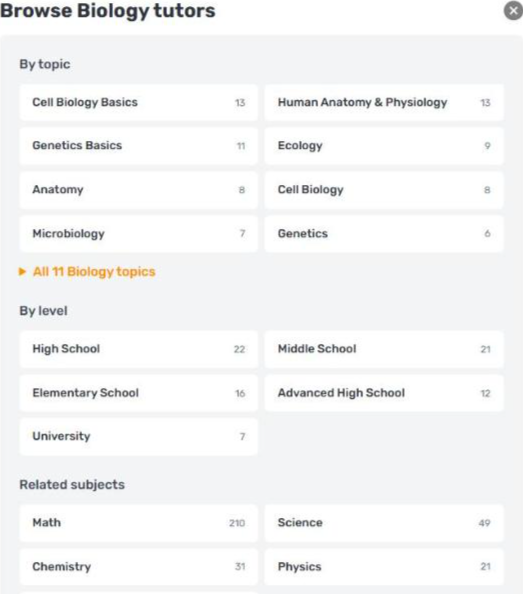
Once you know the reason, searching gets easier. On Tutorela you can filter by subject, level and sub-topic, and each result shows the tutor's description, rating, school or institution, and the subjects they teach.
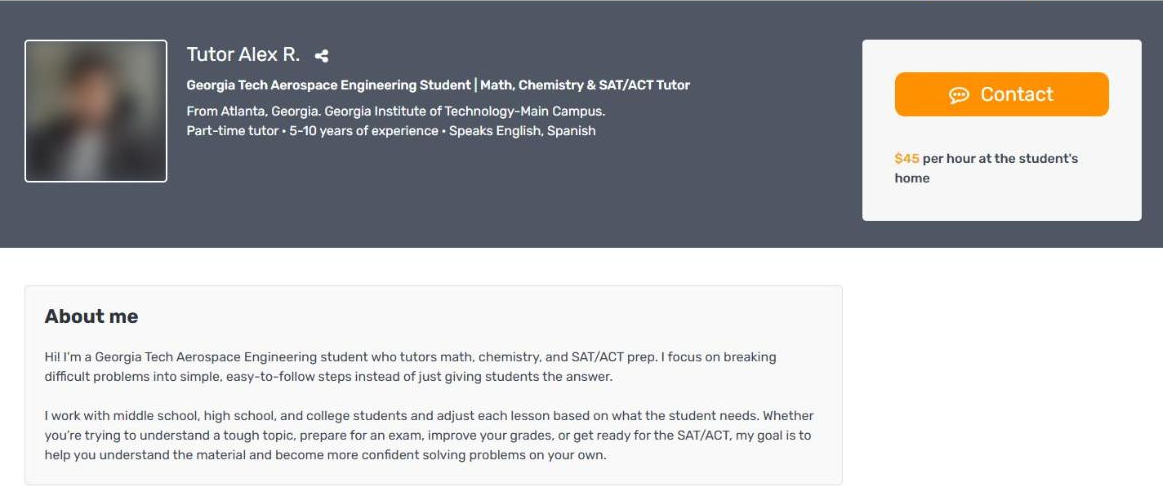
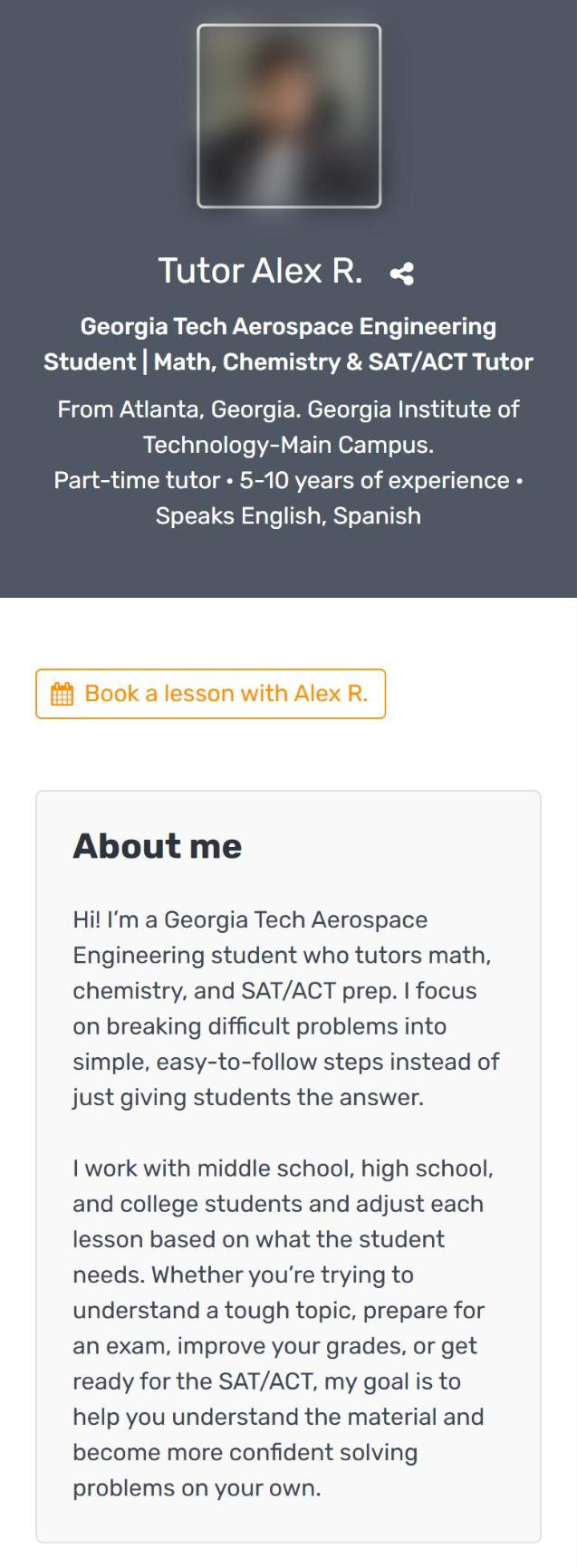
Read the "About me" section closely
The tutor's own description is the best clue to how they actually teach. A good one is specific. "I tutor math" tells you little. "I work with middle schoolers who've fallen behind in fractions and pre-algebra, and I start by finding exactly where the gap began" tells you a lot. As you read, look for:
- Who they usually teach: ages, grade levels and the kinds of students they mention. A tutor who works mostly with college students may not be the best match for a 5th grader.
- How a lesson works: do they explain their approach, like step by step, lots of practice, or projects? A description of what actually happens in a session is a good sign.
- Experience that matches your reason: years of teaching, a specific exam they prep for, training in learning differences, or work in the field.
- Support between sessions: practice assignments, progress updates for parents, or a study plan before a test.
- The goal they aim for: "helping students work on their own" or "building confidence" says more than a list of subjects.
Then match it to your reason:
- Catching up: phrases like "building foundations" or "working with students who are behind," plus a clear first step for finding the gap.
- Staying on track: experience with your child's age group and with year-long support, and steady weekly availability.
- Test prep: the test named in the profile (AP Bio, SAT Math, ACT Science) and how they structure the weeks before it.
- Enrichment: depth, like a degree or work in the field, projects and real interests they bring to lessons.
Check the reviews, including reviews from other sites
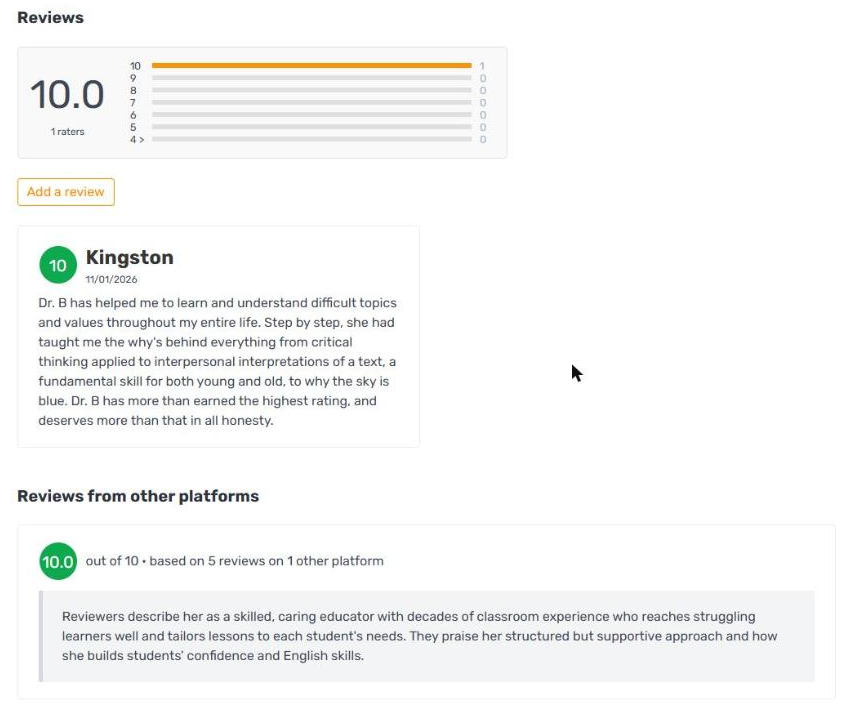
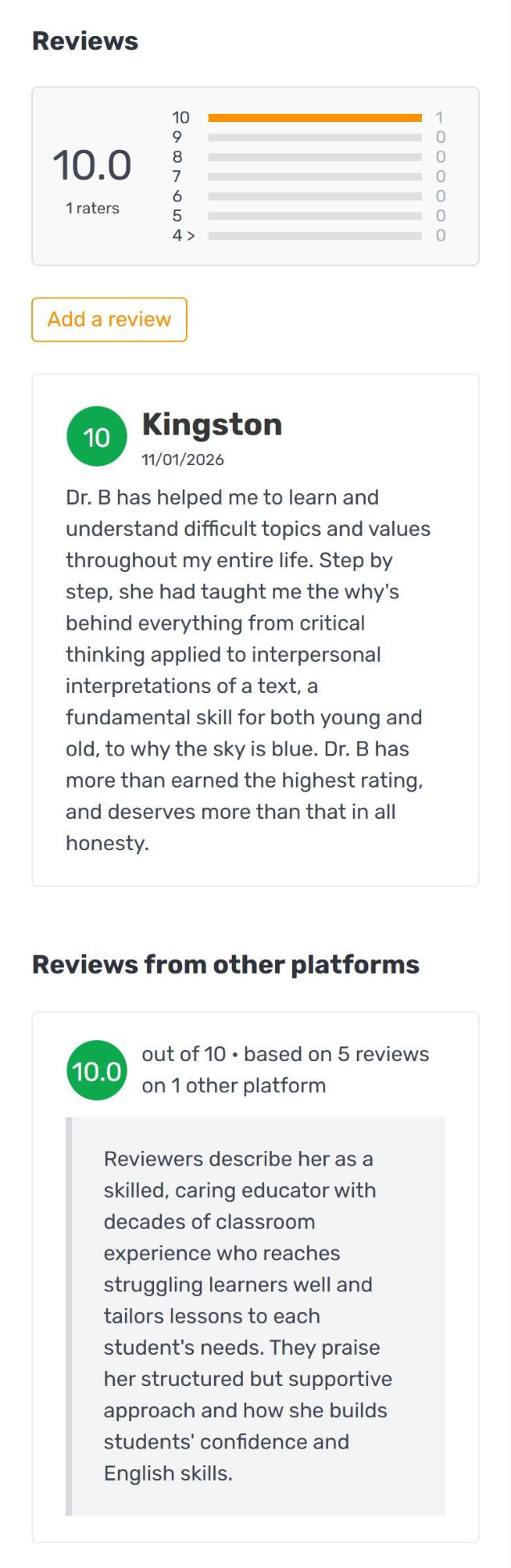
Reviews show whether the description holds up. On Tutorela you'll find two kinds: reviews from students and parents on the site, and a short summary of reviews the tutor has collected on other tutoring platforms, with the overall rating and the number of reviews it's based on. Read them with your reason in mind: stories of kids who started behind and caught up, relationships that lasted months, before-and-after test scores, or comments about curiosity and atmosphere.
Coming soon: more detail in every profile
We're adding a short teaching questionnaire to tutor profiles, so you won't have to piece everything together from the description. Soon, profiles will also show each tutor's teaching style, the support they offer between lessons, the students they work best with (like students who need to catch up or advanced learners), the learning goals they help with, the levels they teach, the specific topics they cover in each subject, and any exam experience. In other words, the four reasons in this guide will be easier to spot right on the profile.
Then talk to the tutor
Messaging a tutor is free, and you can get their contact details for a phone call before you commit to a lesson. Use that call to share your one main reason, your timeline and what success looks like, then listen to how they'd approach it. Once you've chosen, here's how to prepare your child for their first lesson with a tutor.
A first message you can adapt: "Hi, I'm looking for a tutor for my daughter, who's in 10th grade. Our main reason is catching up in chemistry. Our goal is for her to handle her homework on her own by winter break, and we're hoping to meet twice a week for now. How would you approach this?"
FAQ
What are the four reasons a child might need a private tutor?
Most families look for a tutor for one of four reasons. Catching up: your child is behind the class and needs missed skills rebuilt. Staying on track: grades are fine, but only with steady weekly help. Test prep: there's a specific exam on the calendar, like an AP exam, the SAT or a final. Enrichment: your child is ahead, bored, or eager to go deeper. Each reason calls for a different pace, length and kind of tutor.
How do I know which of the four reasons fits my child?
Start with three questions: Why are you looking now? Is there a test date on the calendar? Is your child behind, on track or ahead compared to the class? A date points to test prep. Behind points to catching up, on track to steady support, and ahead to enrichment. If you're not sure where your child stands, ask the teacher.
How many tutoring sessions a week does my child need?
It depends on the reason. As practical starting points from our team's experience: often two a week at first to catch up, one a week to stay on track, one a week rising to two or three in the final weeks before a test, and once a week or every other week for enrichment.
How long does it take to close a gap?
It depends on the size of the gap and the subject. A review of nearly 200 studies, summarized by NCTQ, found strong effects for tutoring held more than three days a week, or at least 50 hours over 36 weeks. You should see early signs, like more confidence and less frustration, well before that. In our team's experience, if nothing has changed after 8 to 10 sessions, it's time to talk with the tutor.
Why not just get help with this week's homework?
Because it usually only helps until the next unit. If your child is struggling because of a gap from an earlier grade, homework help brings relief for a few days, but the missing piece underneath is still missing. A good catch-up tutor finds where the gap started and rebuilds from there, even if that means going back a few grades.
When should we start prepping for the SAT, ACT or an AP exam?
Earlier than you think, at a low pace at first. Research on spaced learning shows that the further away the test, the more it pays to spread review out. A practical plan is one session a week two to three months out, two a week about a month out, and two or three a week in the final weeks. Starting early also means more tutors with open time slots.
Does a child with good grades need a tutor?
Not necessarily, but sometimes it's exactly what they need. A student who only keeps up thanks to steady weekly help may slide if it stops. A strong student who's bored, or who wants to explore something school doesn't teach, can benefit from an enrichment tutor. In one study of high-ability elementary students, teachers cut 40% to 50% of material the students had already mastered, and their test scores didn't suffer.
What if my child has more than one reason?
Pick one main reason to set the pace. If a test is close, the date wins: work toward it and close only the gaps the test requires. If the test is far away, close the gap first, because test prep won't stick without a foundation.
What if the need changes midway?
Update the plan. That's usually a good sign. A closed gap often turns into a calmer weekly session. A finished test leads to wrapping up or continuing at a lighter pace. A child who's caught up and feels confident may be ready for enrichment. Sit down with the tutor, reset the goal, the pace and the end point, and check that the tutor still fits the new need.
How can I tell the tutoring is working?
You don't have to wait for a report card. After about a month, check whether your child solves the kind of problems that used to stop them, spends less time on homework, asks you for help less often, and can explain why they got something wrong.
When don't we need a tutor?
If your child understands the material when you ask about it, does homework independently, and the drop showed up on one test without repeating, it's reasonable to wait a few weeks. Talking to the teacher, using the school's free help, or changing study habits can sometimes solve the problem on their own.
What should I look for in a tutor's profile?
Read the About me section closely: who the tutor usually teaches, how a lesson works, experience that matches your reason, support between sessions and the goal they aim for. Then check the reviews, including the summary of reviews from other platforms, and message the tutor to talk it through before the first lesson.
Should we choose online or in-person tutoring?
Either can work for any of the four reasons. Online gives you a much wider choice of tutors, which matters most for test prep and enrichment, where you want someone who knows a specific exam or field. In person can help younger kids and kids who struggle to focus on a screen. Our guide to who online tutoring is right for goes into more detail.
Know your reason? Find the tutor who fits it. Browse detailed profiles, message tutors for free, and talk it through before the first lesson.